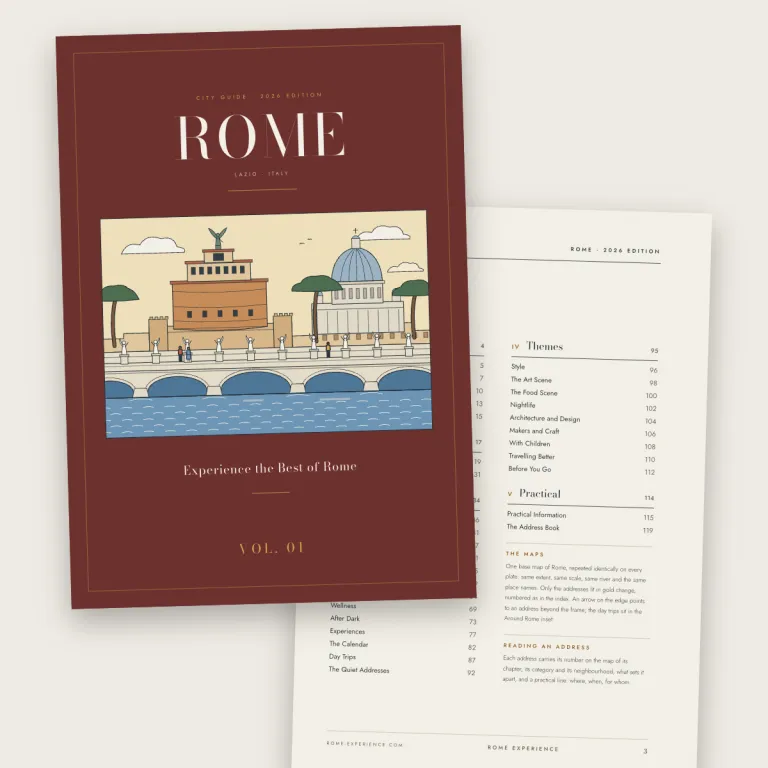
Rome does not introduce itself. That is the first line of our guide, and the problem it tries to solve. Much of what a visitor expects to wander into now works by reservation: the Pantheon has charged admission since July 2023, the Galleria Borghese admits visitors only in two-hour slots capped at 360 people, and Colosseum tickets are issued in the holder's name. A trip to Rome is now decided weeks before the flight. The 2026 edition of City Guide Rome is out, and it was written for that trip.
What is inside
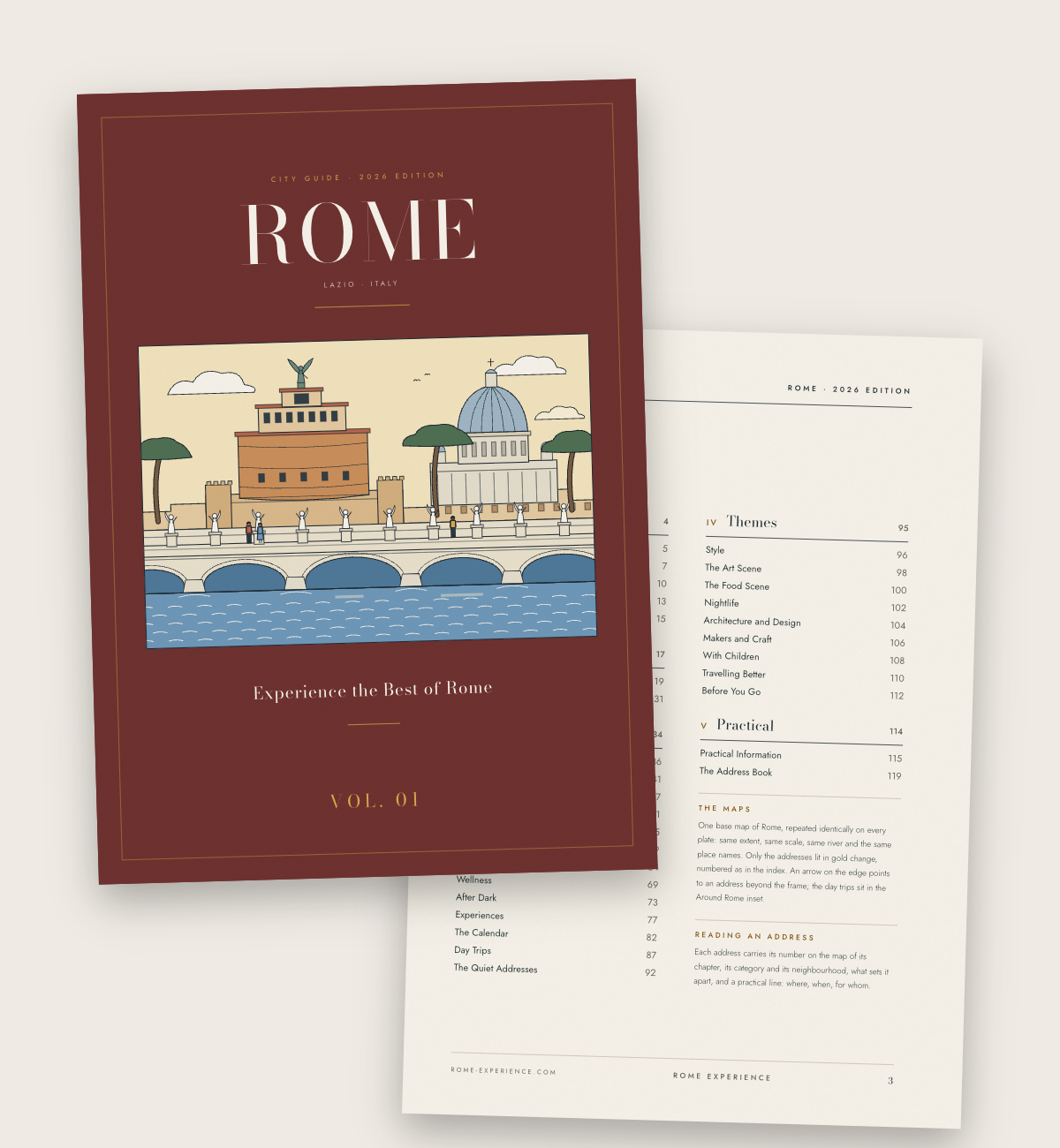
122 plates. 102 numbered addresses. 22 maps. 30 illustrations. Three itineraries. Five parts: the opening, the territory, the address book, the themes and the practical chapters.
The address book is the heart of it: 10 places to stay, 12 to eat, 8 to drink, 6 for coffee and the early hours, 10 for shopping, 10 for culture and heritage, 8 outdoors, 5 for wellness, 6 after dark, 8 experiences, 8 dated events in the calendar, 6 day trips, and 5 quiet addresses for readers who already know the city.
Eight neighbourhoods rather than one city
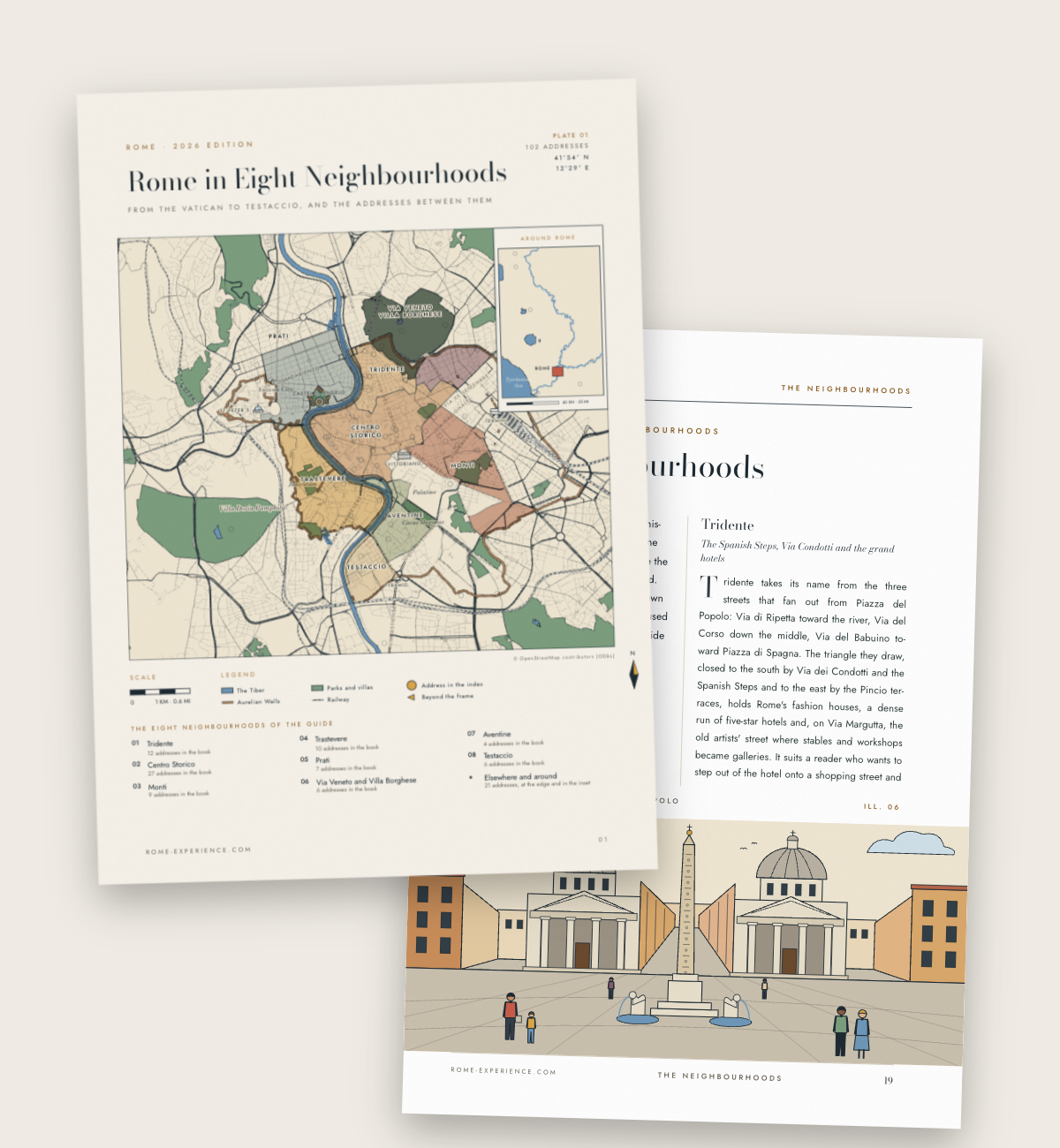
Rome is walked, not driven, so the guide reads it neighbourhood by neighbourhood, and the addresses are spread the way the city really is: 27 in the Centro Storico, 12 in the Tridente, 10 in Trastevere, 9 in Monti, 7 in Prati, 6 around Via Veneto and Villa Borghese, 6 in Testaccio and 4 on the Aventine. Fifteen more sit elsewhere in Rome, from the Appian Way to Monte Mario, and six are day trips beyond the city.
Each neighbourhood gets its own page and a verdict on who it suits. Monti, the old Suburra where Julius Caesar grew up, is described as a good base for four or five days, for travelers who want the ancient city at the door without the density of the center.
22 maps on a single base
Every map in the guide repeats the same drawing of Rome: same extent, same scale, same river, same place names. Only the addresses lit in gold change, numbered as in the index. One map shows the whole guide, one covers each neighbourhood, one each chapter of the address book. An arrow on the edge points to an address beyond the frame, and the day trips sit in an Around Rome inset.
Every address says why it is there
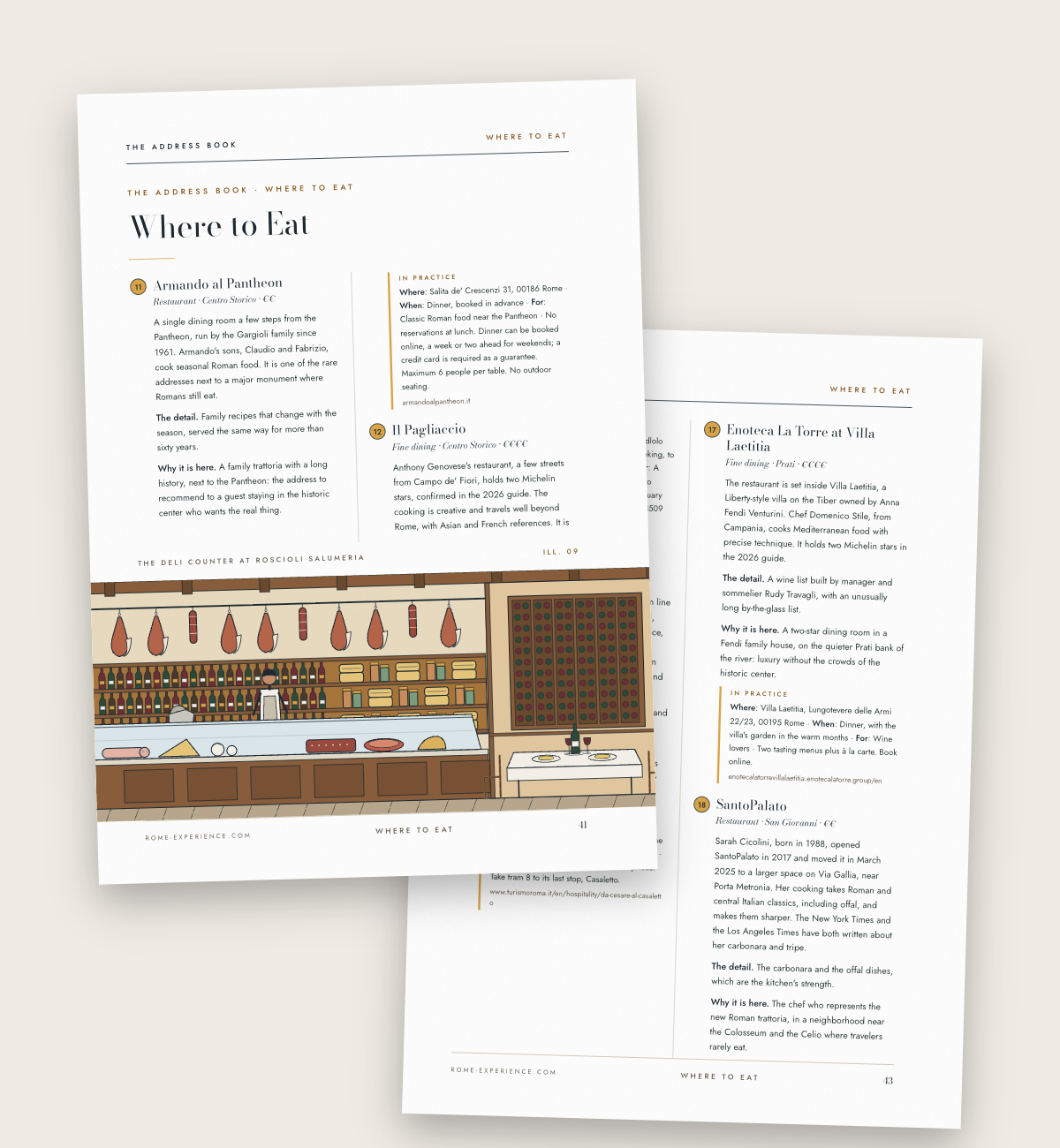
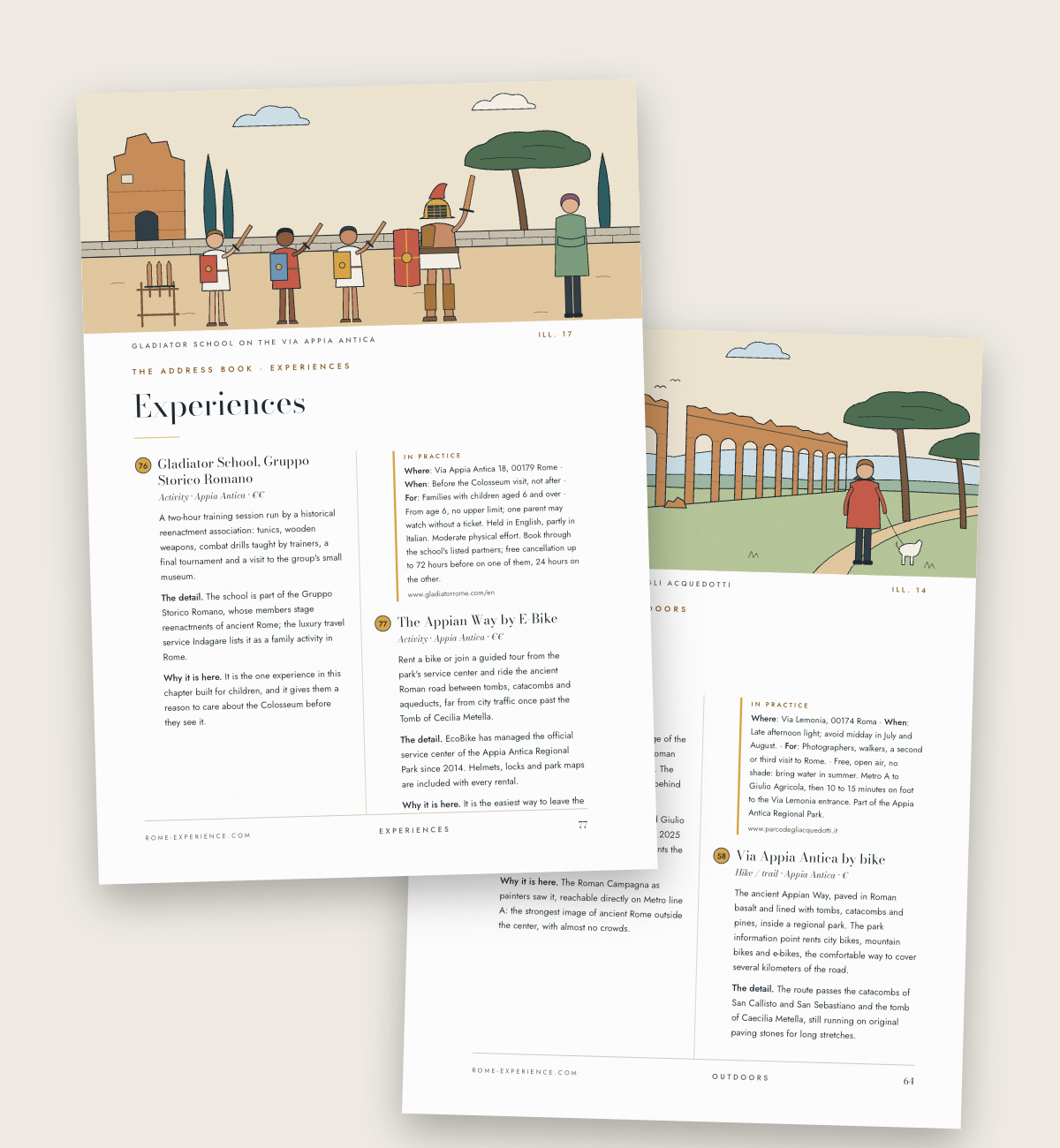
An entry carries its number, its category and its neighbourhood, a detail that sets it apart, a line headed "Why it is here", then a practical block: where, when, for whom. The Where to Stay chapter opens with Hotel San Anselmo, a 19th-century villa on the Aventine with thirty-four rooms and breakfast under a wisteria pergola in summer, the accessible end of the guide's range. Two entries later comes Six Senses Rome, an 18th-century palazzo off Via del Corso whose spa recreates the sequence of the Roman baths, caldarium, tepidarium and frigidarium.
Where to Eat starts next to the Pantheon, at Armando al Pantheon, run by the Gargioli family since 1961, one of the rare addresses beside a major monument where Romans still eat. It goes on to SantoPalato on Via Gallia, where Sarah Cicolini cooks Roman offal and pasta with precision, and to two Michelin-starred tables in a Liberty-style villa on the Tiber.
Three itineraries, built only from the addresses in the guide
One day, three days and five days, each route extending the last. The one-day route goes on foot from the Pantheon to Villa Borghese, any day but Monday, when the Galleria Borghese is closed, or Wednesday, when the Galleria Doria Pamphilj is. It starts with an espresso standing at the counter of Sant'Eustachio Il Caffè at 8:15 am and depends on one booking made before anything else: the 3:00 pm Borghese slot, since there are no tickets at the door.
The five-day route adds the Vatican from 6:00 am with the Key Master's Tour, which opens the Sistine Chapel before the crowds, and a last day out of town: Tivoli, the Appian Way by e-bike, or Orvieto. Opening days and booking windows decide the order more than distances do. Book the tickets first, the tables second.
What it leaves out
What can be seen from a queue. The guide ends its address book with five quiet addresses, and they are about access rather than fame. Jerry Thomas Speakeasy, behind an unmarked door, where you give your name and a secret word. The Casino dell'Aurora Pallavicini, whose ceiling by Guido Reni opens to the public one day a month. The Colonna family's palace, open on Friday and Saturday mornings. And the Vatican Necropolis, two levels below the floor of St. Peter's, which cannot be bought through any reseller: the only way in is a request to the excavations office.
When to read it
Before booking rather than after. Rome has no closed season, but each quarter changes the heat at midday, the lines at the Vatican and the Colosseum, and the nightly rate at the good hotels. The guide dates what can be dated, the closing days, the booking windows, the events of the calendar, so that the trip is built with the city's timetable rather than against it. It opens in the browser, and it is free.